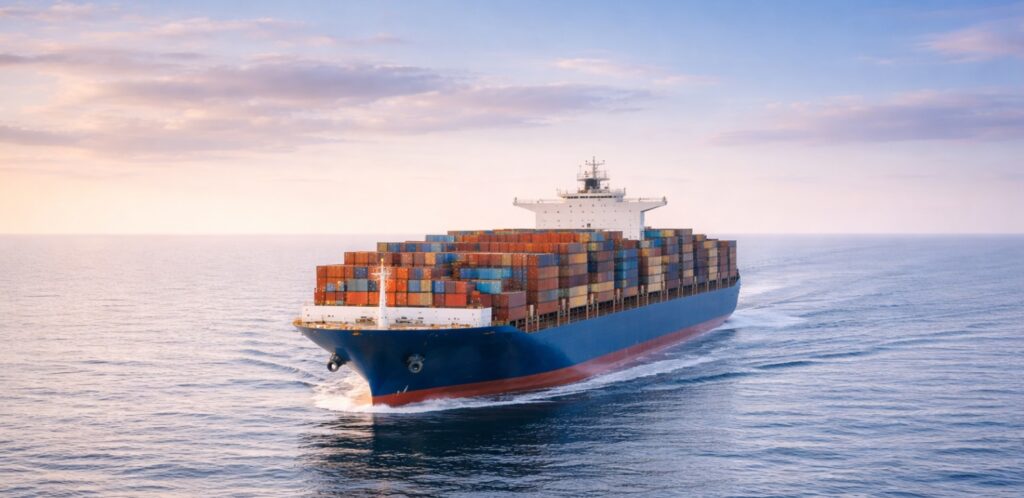
The first commercial container vessels to test new Asia-Europe services through the Northern Sea Route (NSR) have arrived in Europe, drawing renewed criticism from environmental campaigners even as operators tout sharp cuts in transit time and emissions, according to Ship & Bunker.
Chinese Carrier Opens Weekly Arctic Express
The Liberia-flagged, 1,740 TEU Dubai Tower, operated by Chinese carrier Sea Legend, docked at Teesport on the evening of September 9, roughly 20 days after departing Chinese waters, according to Ship & Bunker, citing comments from chief operating officer Li Xiaobin to the Global Times. The vessel loaded cargo at Ningbo, Shanghai, Taicang, and Qingdao — a port sequence altered by Typhoon Dolphin — carrying 1,370 TEU of energy storage containers, power batteries, and photovoltaic modules, the company said.
Sea Legend reported that the ship’s route through the Northeast Passage was continuously adjusted based on ice forecasts, generating data on open-water and ice-covered speeds, fuel consumption, and ice-related delays. Ship & Bunker notes the voyage marks the first of eight Arctic transits Sea Legend plans this season, with the vessel continuing to Felixstowe, Hamburg, and Gdynia before returning to China via the Suez Canal.
Li was quoted as saying the route is expected to cut one-way transit time to about 20 days — nearly half the duration of conventional routes — while reducing per-voyage carbon emissions by roughly 50 percent.
South Korean Trial Follows Close Behind
A second vessel, the 2,758 TEU PanStar Acro, sailing as part of a South Korean government-backed trial, reached Felixstowe on September 12 after 21 days at sea from Busan, according to media reports cited by Ship & Bunker. The ship was scheduled to call at Rotterdam en route to Gdansk, marking the first Korean container vessel to use the NSR.
Environmental Coalition Raises Alarm
The Clean Arctic Alliance, representing 24 environmental organizations including Greenpeace, WWF, and Transport & Environment, said in a statement reported by Ship & Bunker that expanded commercial use of the NSR risks intensifying climate impacts, ocean pollution, and biodiversity loss in the Arctic. The coalition’s lead advisor, Sian Prior, warned that black carbon from residual fuel combustion accelerates sea ice melt, and argued that neither the IMO’s Arctic HFO ban nor the newly adopted Northeast Atlantic emission control area adequately addresses the issue.
According to Ship & Bunker, Prior noted vessels can still burn HFO outside the ban zone and can meet ECA sulphur requirements using scrubbers or ultra-low sulphur fuel oil — neither of which reduces black carbon to levels achievable with distillate fuels. The coalition also dismissed LNG as a viable alternative, citing lifecycle methane emissions, and is backing a polar fuels proposal from Denmark, Germany, France, and the Solomon Islands currently before the IMO that would mandate distillates like MGO or zero-carbon fuels for Arctic transits.
Does This Matter to You?
According to Ship & Bunker, the appeal of the NSR for operators lies in shorter voyages burning less fuel overall — the basis of Sea Legend’s emissions claims — at a time when Red Sea diversions have already lengthened traditional Asia-Europe routings. This has implications for fuel consumption planning, voyage economics, and bunkering strategy on Asia-Europe trades, as well as for parties tracking regulatory developments around Arctic fuel standards. The outcome of the polar fuels proposal at the IMO could also affect future fuel requirements for vessels transiting Arctic waters.
Gulf Bunkering does not provide operational or security guidance. This article is for informational purposes only. Operators should consult flag state authorities, P&I clubs, and relevant advisories for decisions relating to transit planning.
Sources: Ship & Bunker